During 2010-11, the agriculture continues to remain an important sector of Pakistan’s economy. Its contribution was 21 percent to GDP. It generated employment opportunities for 45 percent of the total labour force and 60 percent of the rural population depends upon this sector for its livelihood. It has a vital role in ensuring food security, generating overall economic growth, reducing poverty and the transforming towards industrialization, said Economic Survey.
In agriculture sector livestock adds value of 55 percent in agriculture products, and 11.6 percent to GDP during 2010-12, as against 54.6 percent and 11.6 percent during the same period last year. It is much more than the combined share of major and minor crops, whose share is 42 pc. The sector is a big source of foreign exchange earnings. Gross value addition of the livestock sector, at constant factor cost, has increased from Rs672 billion in 2010-11 to Rs700 billion in 2011-12; showing an increase of 4 percent as compared to previous year.
Traditionally, livestock has been the subject of small land holders to meet their needs of milk, food and daily cash income. Therefore, livestock is a more secure source of income for the small farmers and landless poor.
The population growth and increase in per capita income and the potential for export has resulted in an increase in the demand of livestock and their products. However, rise in production cost has affected the retailers and consumers. prices of milk, yogurt, meat, eggs, and other items are continuously increasing.
The officials said emphasis will be on improving per unit animal productivity and moving from subsistence to market oriented and then to commercial livestock farming in the country to meet the domestic demand and surplus for export.
The Livestock Wing is taking regulatory measures that included: allowing import of high yielding animals, semen and embryos for crossbreeding. It also included duty free import of veterinary dairy and livestock machinery and equipment, allowing import of feed inputs and vaccines at zero rates. In order to reduce input costs in livestock, poultry feed production, certain feed ingredients, growth promoters and vitamin premixes have been zero rated.
Sales tax exemption has been allowed to uncooked poultry meat; processed milk, yogurt, cheese and flavored milk, butter and cream in order to encourage establishment of a value added industry in the country. More than 9500 exotic animals, 318,768 semen doses and 4300 embryos of high yielding animals have been imported from July 2010 to December 2012.
New slaughterhouses, milk and meat processing units have been established in the private sector. The export of the meat, beef, mutton and camel meat has increased from $108.54 million in 2010-11 to $123.61 million in 2011-12, showing an increase of 13.9 percent.
The future plan for the livestock sector is to implement policies to achieve 5 percent in meat and 8 percent in milk production through commercial farming. The focus will be to encourage and promote high yielding animal’s production and their crossbreeding through artificial insemination services. The future road map aims to enteri into global Halal Food Trade Market, controlling trans boundary animal diseases of trade and economic importance.
The livestock sector includes cattle, buffalo, sheep, goat, camels, horses, asses and mules. Milk, meat, wool, hair, bones, fat, blood eggs, hides and skins are the main livestock products among which milk and meat are taken as major products. Besides this, these animals are used for draught purposes.
Pakistan is fourth largest milk producing country in the world. Milk is produced by buffalo, cattle, sheep, goat and camel but being major contributor in milk production, cattle and buffalo are considered as major dairy animals and are always mainly focused.
Mega Development Projects
The Ministry of Livestock and Dairy Development, set to start 7 projects in the Livestock sector at an estimated cost of Rs8.8 billion. The strategy include strengthening of
Livestock Services Project (SLSP): field studies on 5 models of service delivery were conducted (CAHEW, WLEW, DFCM,
Wool Producers Association and PRSM); introduced PPR vaccine production in the country; distribution of 2200 motor cycles to field staff of provincial livestock departments on hire purchase basis to strengthen and improve the veterinary health coverage; and establishment of the National Epidemiology Network for Livestock Disease Surveillance and Reporting.
Livestock Production and Development for meat production include: Completed more than 13,000 feed lot fattening operations for beef and mutton in which more than 163,000 beef animals and 200,000 mutton animals have been produced.
Milk Collection Processing and Dairy Production and Development Programme: Formed 207 Milk Producer Groups (MPG) in all the four provinces, Azad Jammu and Kashmir and Gilgit Baltistan, installed 150 milk cooling tanks, provided 63.3 ton of fodder seeds and 663 tons of animal ration, feed on cost basis to the members of MPGs, registered 1,004 Red Sindhi, Sahiwal and NiliRavi livestock breeders for production of quality breeding animals.
Prime Minister’s Special Initiative for Livestock (PMSIL): A total of 290 veterinary clinics have been established providing veterinary services at 70 percent reduced cost to rural farmers at their door steps. Besides, quality medicines and vaccines are also available to rural farmer at 30 percent reduced costs as compared to market prices.
A total of 3,150 community organizations (COs) have been formed and 3000 rural community persons have been trained by imparting one month training in basic veterinary services through the government livestock institutes.
A total of 4,265 rural livestock female farmers have been trained in better animal husbandry practices to enhance their income through enhanced milk productivity National Programme for the Control and prevention of Avian Influenza. Established 40 surveillance and 66 rapid response units (RRUs), processed 0.4 million samples of blood, tissues and swabs for screening against Avian Influenza, establishment of the Bio security Laboratory-3 is under process. So far Rs23.5 million has been disbursed as compensation to Avian Influenza affected farmers.
Pakistan is maintaining Avian Influenza (bird flu) free status since June 2008. Improving Reproductive Efficiency of Cattle and Buffaloes in mall holder production systems have been carried out in 168 animals.
Provided training to artificial insemination technicians up gradation and Establishment of Animal Quarantine Stations in Pakistan.
Five Animal Quarantine Stations (AQS) have been up-graded in order to facilitate import, and export of livestock and its products
Two new AQS are being established at Khunjrab and Khokhrapar.
The cattle breeds found in the country are Sahiwal, Cholistani, Red Sndhi, Achai, Bhagnari, Dajal, Dhanni, Gibrali, Kankraj, Lohani, Rojhan, and Thari. Out of these, Sahiwal, Cholistani, and Red indhi are main dairy breeds and well known internationally due to their distinct characteristics. Other than well-defined cattle breeds, there are a large number of nondescript cattle breeds and crossbred cattle. Goat is considered as `poor man's cow'.
More than 96pc of the milk comes from cattle and buffalo. The rest of it is collectively produced by sheep, goat and camel. Milk is favorite food in Pakistan and is consumed as fresh, boiled, powdered and in processed form as yogurt, ghee, lassi, butter, cheese, ice cream, sweets and in other confectioneries.
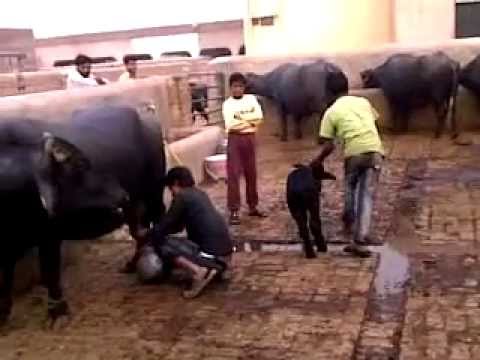
Till late eighties, more than 60pc of buffaloes and some cows were maintained under the system of Rural Subsistence Production System. In this system on an average the holdings were based on 3 to 4 dairy animals with one or two adult females.
In 1980s, dairy sector moved towards commercialization. These commercial farms consisted of about 30 animals of which 70pc were females. About 40pc of these adult females were in milk during most of the year.
With growing demand for milk in urban areas rural commercial dairy farming moved toward peri urban areas. In these areas there were large and small dairy herds consisting of 20 to 50 animals with nearly 90pc of adult females in production. Male calves are disposed off within first two weeks of birth.
During the last ten years major changes has been occurred in dairy sector of Pakistan and due to these change this sector has become an industry. A large number of modern dairy farms have been established across the country. Most of these dairy farms have exotic animals and number of these animals is in hundreds and even in thousands and planning to enhance 3000 animals to 5000 animals. Such farms have adopted most modern management and feeding practices and have well trained man power. Milk produced on these farms is either sold out in processed or fresh form through outlets or departmental stores etc. or supplied to dairy companies.
To help dairy farmers Punjab Livestock and Dairy Development Board (PLDDB) has launched Pakistan's first online dairy farming guide. This website has also been associated with the social media of India.
Livestock provides livelihood of the rural poor and can play an important role in poverty alleviation. It can uplift the socioeconomic condition of Pakistan’s rural areas, therefore, needs especial attention.
Presently, the tanning and leather industry is facing shortage of raw materials problem. Pakistan Tanners' Association (PTA) blamed that the government has not incorporated even one of its proposals, as usual, in the Federal Budget 2012-13.
The PTA CM, Shaikh M Naseem, demanded that complete ban on export of pickled, wet blue raw hides and skins and splits should be imposed, which is being exported through wrong declaration or under invoicing to evade the payment of existing regulatory duty imposed at the rate of 20 percent. This has resulted in loss to the industry and also deprived the country of considerable amount of regulatory duty.
Export of live animals from Pakistan through Quota CY12 and smuggling of live animals should also be banned. The import duty must be reduced on the basic chemicals from 20pc to 10pc that would result in a reduction in cost of production. It would enable exporters to compete in the international market.
Withholding Tax (Presumptive Tax) on import should be reduced from 1pc to 0.25pc, reducing duty to 5pc on hot stamping foils falling under H.S. Code 3212.1000, which is currently charged at the rate of 20pc, reducing duty to 5pc on polyester foils falling under H.S. Code 3920.6900, which is also currently being charged at the rate of 20pc.
The industry also demanded to allow duty free import of all spare parts, accessories and tanning machinery for leather and leather products. Presently, a 5 percent duty is charged. Calling for exempting all spare parts of tanning industry from Sales Tax, the industry said that there was a need to exempt all hot stamping foils or polyester foils for leather industry from Sales Tax and anti dumping duty on all chemical items should be withdrawn.
The government has not given incentive to the leather sector for the last many years as compared to other neighboring competitor countries such as India, China and Bangladesh. At present, only 60pc to 70pc of installed capacity is being utilized owing to high cost of production and shortage of raw materials. Resulting, several units have been closed down. In view of the critical situation, the leather sector, which is the second biggest export oriented sector and contributes 5pc to the country's GDP, needed immediate government support.